National Parks
From Acadia to Alaska
Catalog at a glance — 1784 patches across 201 themed collections. These counts are pulled live from the catalog every time this page renders.
Scout is the field guide to the real world: a travel companion app that turns a road trip, a national-park visit, or a history detour into a living collection. The promise is simple — go see the world, earn the patch, keep the journey. The core loop is three steps: discover a place worth the stop, navigate there with the in-app compass or a planned trip, and unlock a patch when you physically arrive. Each digital patch is rendered as an embroidered iron-on and presented full-screen the moment it is collected.
The defining rule is "earned, not bought": you collect a patch only by standing in the place. The unlock is polygon containment against a real boundary — you have to actually be inside the park, the city, the battlefield. There is no proximity radius to describe and no way to fake it from the couch.
The catalog spans thousands of real-world locations organized into hundreds of themed collections, which are in turn grouped into a small number of curated campaigns — National Parks, State Parks, Route 66, City Challenges, the 50 States, Civil War, Founding & Revolution, Native America, Wild West, Ghost Adventures, Roadside Attractions, National Forests, Sports, Zoos, Aquariums, Major Airports, and long-form Road Trips. (Live totals are in the snapshot at the top of this page; the full structure is in the Campaign Index and Collection Index below.) Each patch carries a short editorial write-up, a chronological history, a location card with credited photography, a photo gallery, and its own community board — the app is essentially a field guide to America, playable like a game.
Scout is free, and there is nothing paid inside it — no subscription, no premium tier, no in-app purchase of any kind. All revenue comes from physical embroidered goods sold through a separate storefront. Getting in takes one tap — Google, Apple, or a one-time 6-digit email code — and every entrance is find-or-create, so signing in with no account simply makes one. A fourth path, guest mode, is fully built server-side, but its "Continue as guest" button sits behind a flag that ships off: do not describe Scout as usable without an account unless that flag has been turned on. Where it is enabled, guest sessions are real backend identities, so camera-roll import, the store, and community posting all work before a user ever links an email; when a guest upgrades to a full account, everything they have collected syncs and follows them across devices.
Automatic unlock is polygon containment, and only polygon containment. As the user moves, the app takes their GPS fix, cheaply pre-filters the catalog on-device, and asks the server one question: which of these boundaries actually contain this point? The server answers with a hard geometric containment test against real boundary polygons — OpenStreetMap footprints, buffered street corridors for linear features like Route 66 alignments, and official National Park Service protected-area boundaries.
This applies to every patch type, including cities and states, which carry real boundary polygons like everything else. That is what lets one location unlock a whole nest of patches at once: a photo taken at the Saint Louis Zoo is inside the zoo, inside Forest Park, inside Saint Louis, and inside Missouri — and earns all four. There is no name-matching or reverse-geocoding anywhere in the unlock path; reverse geocoding exists only to label a place in the UI, never to unlock it. A small fixed radius survives solely as a stopgap for the handful of patches that do not yet have a boundary drawn — a coverage gap being closed, not a design tier.
Two guards matter. A GPS fix coarser than about 75 metres of accuracy is stored so the interface always has a position, but is not trusted to unlock anything. And the app refuses to collect until the account's existing collection has loaded from the server, so a cold start in a state you already hold does not re-collect and re-celebrate it.
The compass is a map-first screen built on Scout's own self-hosted basemap. It draws the actual unlock boundary as a dashed brass polygon, along with the patch pin and a pulsing you-are-here marker, and keeps both in frame as the user moves. A console at the bottom shows live distance as a large serif figure, a heading dial, the location photograph, and one gold action — open turn-by-turn directions, or view the patch once it is collected. The whole proximity vocabulary is three literal states in the top bar: TRACKING, then INSIDE THE AREA, then COLLECTED. Arrival is answered by real geometry — a point-in-polygon test against the boundary the map is already drawing — not by a distance threshold standing in for one, and crossing it fires the collect check immediately rather than waiting out the background batching window.
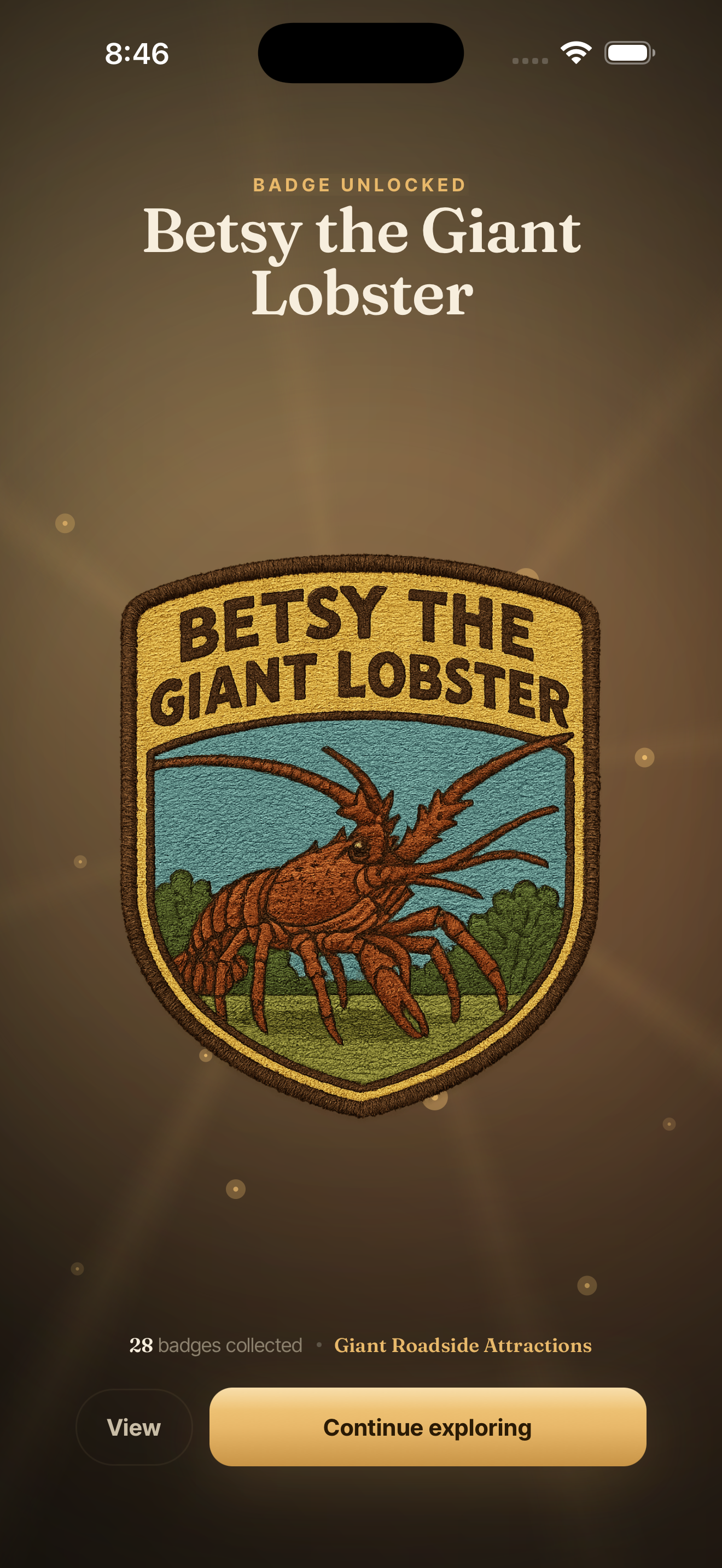
When a patch unlocks, a full-screen celebration takes over: a Skia ember field of warm sparks rising over near-black, then the patch artwork rising as a silhouette, pulsing, and crossfading into full colour with haptics and sound, followed by a "BADGE UNLOCKED" kicker, a light sweep across the art, and the place name. Tapping anywhere skips it, and the OS reduce-motion setting jumps straight to the final frame.
Because one location can unlock several nested patches at once, unlocks are queued — the user is owed one celebration each, played in order. Anything unlocked during onboarding is parked and shown once the user reaches an ordinary screen.
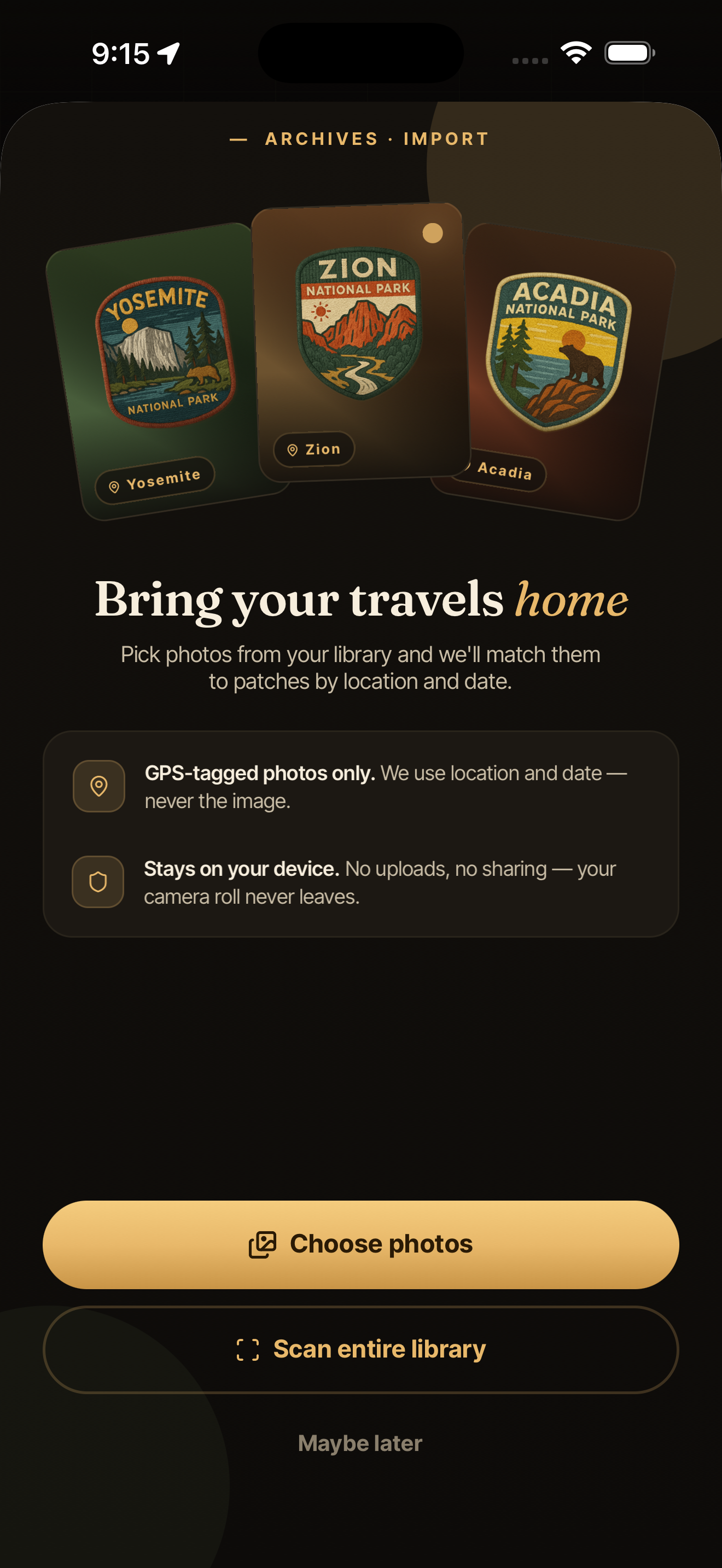
New users do not start from an empty map. Scout can read the user's camera roll, extract where each photo was taken, and retroactively unlock patches for places they have already been — each patch back-dated to the day of the photo, so a first collection retraces real travel. Matching runs on-device and no pixels leave the phone: only coordinates and timestamps are sent, and only to ask which boundaries contain them. Photo matching deliberately uses looser tolerances than live tracking, because photo GPS drifts indoors and many boundaries are tight footprints.
Two planning modes sit on top of the loop. A Day Trip is a short itinerary of nearby stops you can do in an afternoon, built by swiping through a deck of nearby patches or picking from a grid. A Road Trip is a long-lived plan between two places: Scout asks a real routing service for the driving route, finds every patch within a chosen detour distance of that road, groups them by the states you will cross, and then gives you a heading-up driving map that counts down to your next stop while patches unlock passively as you pass through them.
Every patch has its own community board, and a dedicated Community hub gathers a general feed, the boards a scout has favorited, and a search across every board and post. Scouts recommend places, post tips and stories, ask questions before a trip, and upvote what is useful. Authors who have actually collected the patch carry a "visited" badge, so first-hand advice is visible at a glance. Because the patches you earn in the app are the only ones you can order as real embroidered iron-ons, the trip always comes first and the keepsake follows.
Getting these words right matters — several of them look interchangeable and are not.
Content nests in exactly three levels: Campaign → Collection → Patch.
Campaigns are the app's top-level browse surface. A campaign with exactly one collection (Zoos, Aquariums, Major Airports) collapses the middle level entirely and renders its collection directly, so a one-node journey does not put an extra tap between the user and the patches.
@-mention picker. It is derived from the email local part (lowercased, accents folded, +tag and punctuation dropped) with collisions broken by a numeric or id-derived suffix. It is not the profile URL slug, which is a separate value carrying its own hash suffix.Beyond name and artwork: a short editorial summary, a "why visit" pull quote, historical significance, an established date and historical period, a chronological list of key events, notable figures, a location photograph with photographer credit and licence, National Park Service data where applicable (designation, fees, hours, activities, topics), and a type-specific data block appropriate to what kind of place it is. Location imagery is credited — the credit tracks whichever image is currently showing, whether that is the location photo, official NPS imagery, or a scout's own uploaded photo.
anon-<animal>-<number> handle, re-derived from the real address if they later sign up.guest_mode, which ships off, so it is not normally a fourth option (see Feature Status). Where the flag is on, a guest session is a real backend identity, so import, the store, and community posting work immediately; guest purchases migrate on sign-in. Onboarding is two permission screens — location, then notifications — with neutral wording, and the declined-location screen points at camera-roll import as the genuine alternative.scout:// deep link.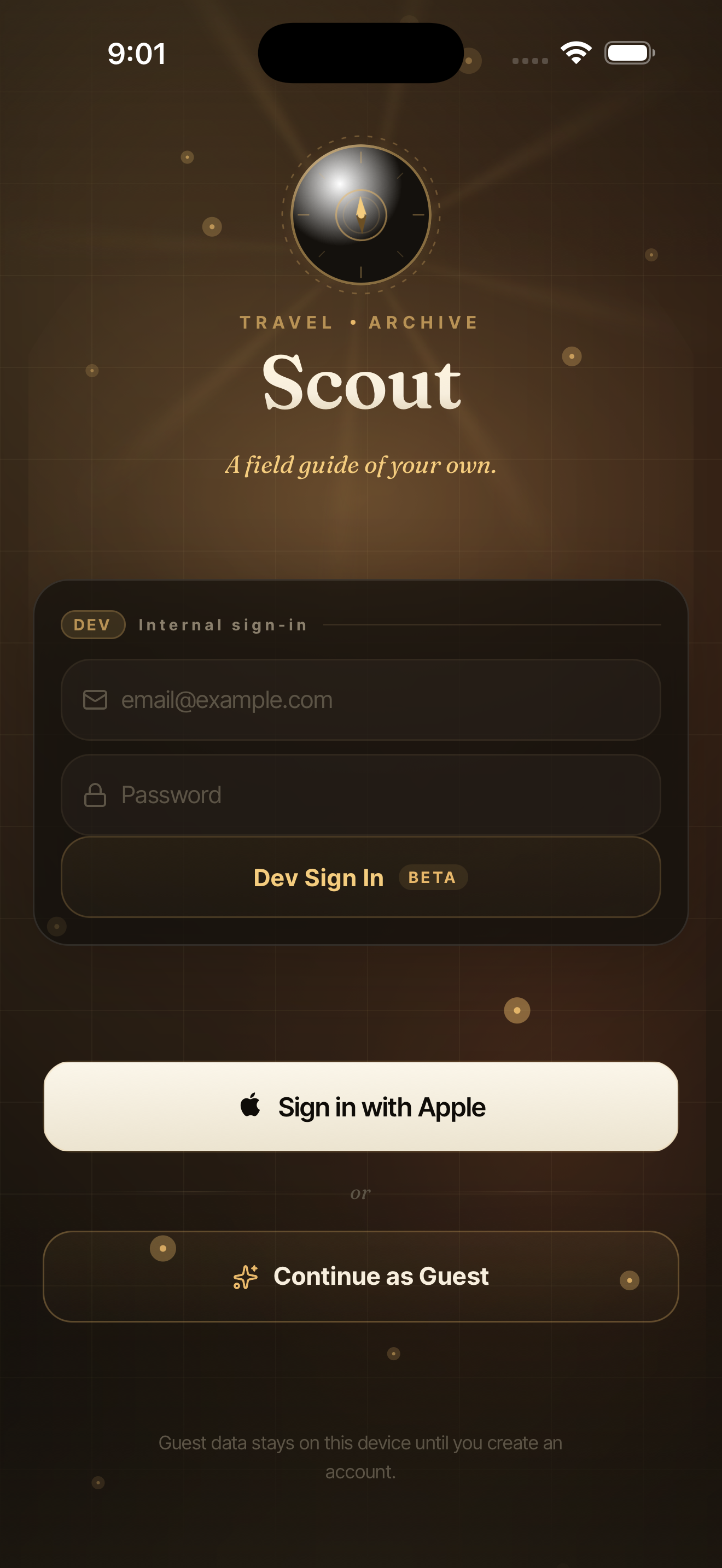
/auth
The sign-in landing, headed by the SCOUT wordmark and the line "A field guide of your own." A ruled "Sign in or create account" label states outright that every entrance is find-or-create — signing in with no account creates one. Apple and Google share a row (iOS; Android is Google alone), then "Continue with email". A "Continue as guest" row exists but is behind a flag that ships off, so it is not normally visible. Footer links open Terms and Privacy in an in-app browser.

/auth/email
Passwordless two-step entry: enter an email and press "Send code", then fill a 6-digit segmented input and press "Verify & continue". The subtitle says the address is signed in OR given a new account, since the Profile is created at code-request time. A "Resend code" link sits behind a 30-second cooldown.

/onboarding-referral
An optional beat during onboarding where a new scout can enter the invite code a friend gave them. Codes are always typed or pasted by hand — opening an invite link never claims a code on the visitor's behalf. Skippable, and enterable later from the invite screen while the claim window is still open.
/onboarding-location
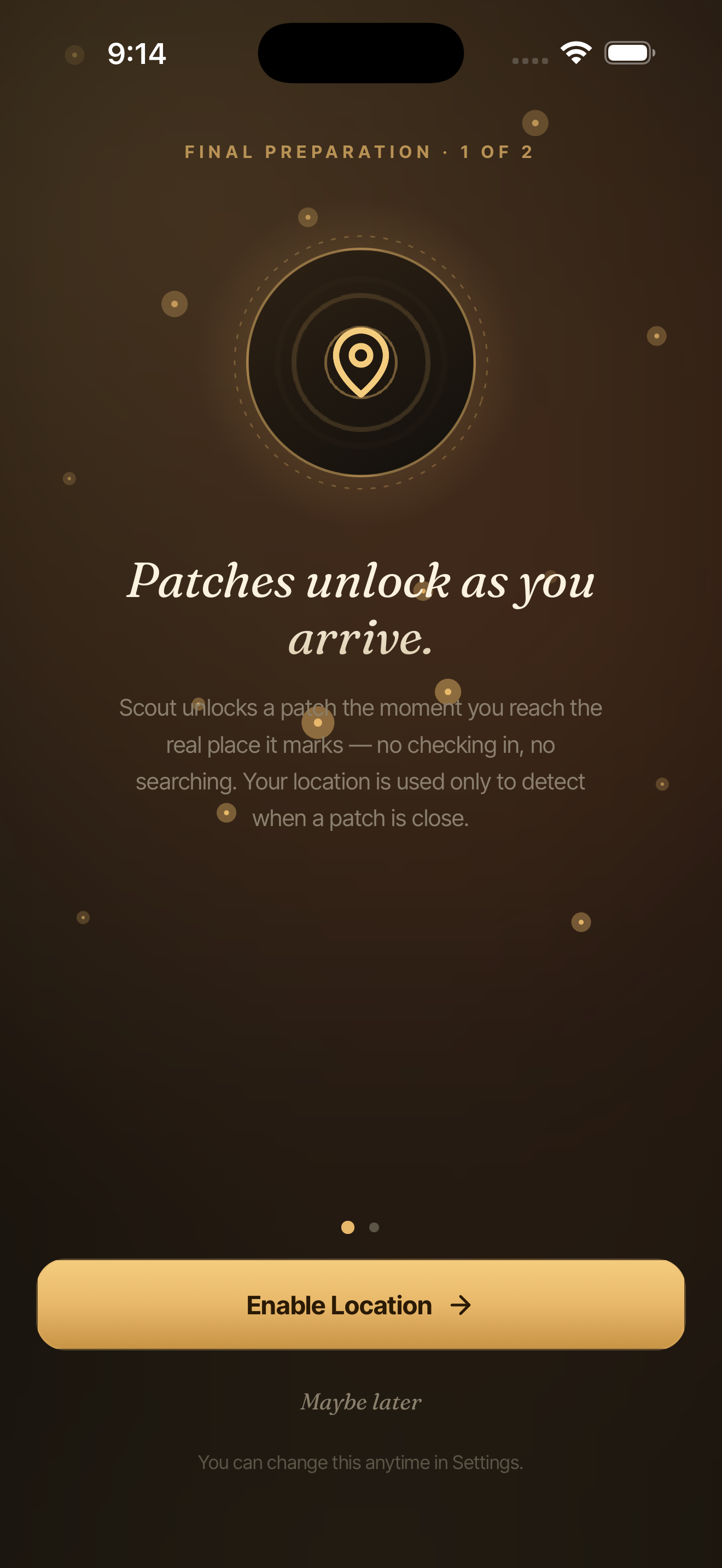
The first permission beat. Continuing fires the OS location prompt; granting holds a brief confirmation then auto-advances, and denying shows a denied state that points at camera-roll import as the alternative.

/onboarding-notifications
The final onboarding beat. Continuing fires the OS notification prompt, then routes home regardless of the answer.

/location-permission
The recovery modal when location is off after onboarding has run. Explains what it enables and offers "Open Settings" or "Continue Without Location".
/(drawer)/
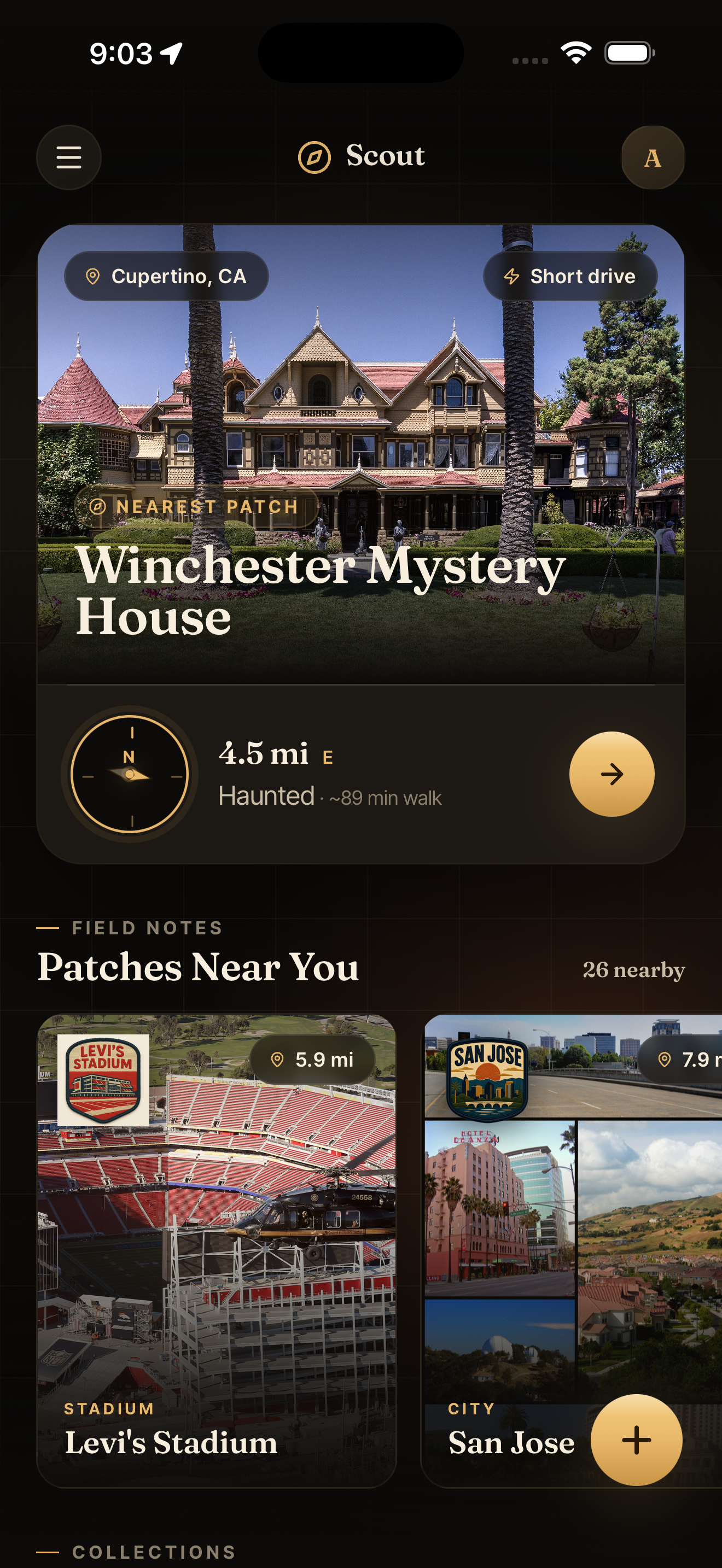
The main dashboard, and the screen that changes most with context. Away from anything it leads with the nearest patch, then a trip or City Challenge slot, a campaigns carousel, a camera-roll import band, and an explorer map card. Close to a city it switches into place mode; inside a national park it says "You’re inside".
/(drawer)/near-me
Nearby patches inside an adjustable "WITHIN" radius dial: a spotlight hero with navigate, check-in and details, a walkable marquee, and lists banded by distance. Empty and all-collected states show a radar prompting you to widen the dial or plan a day trip.
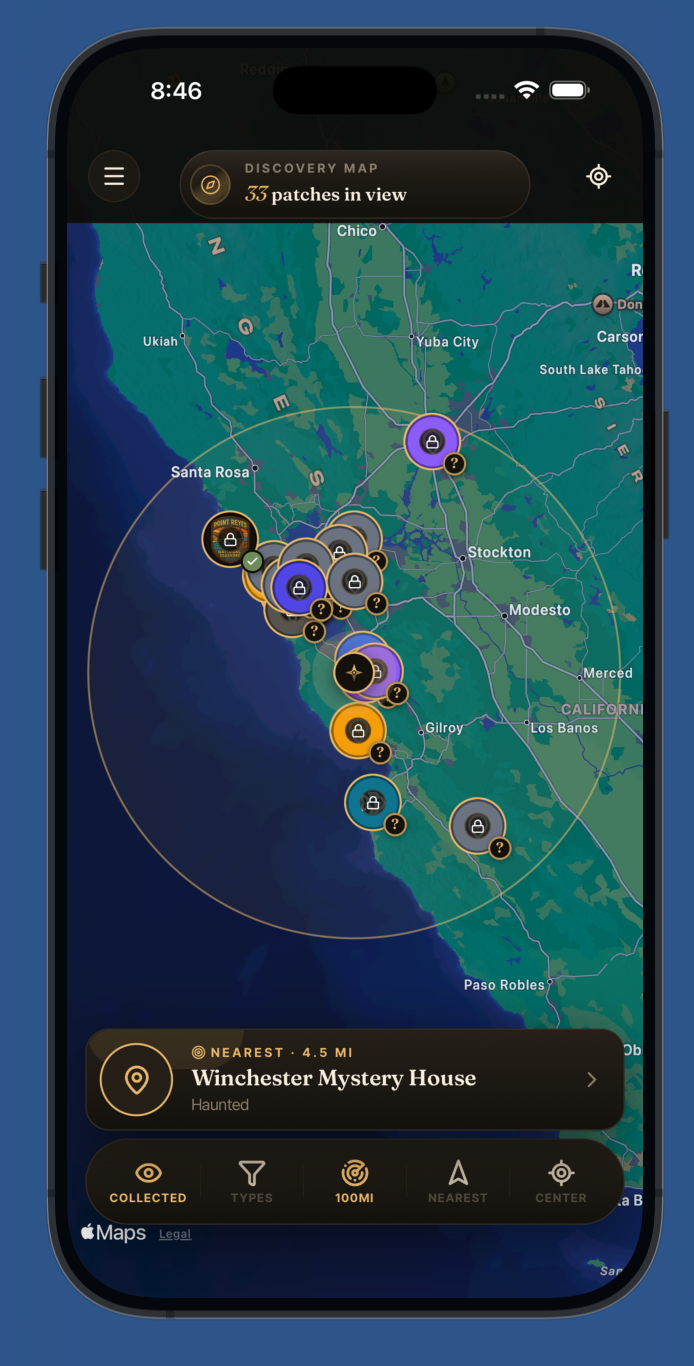
/(drawer)/map
The full-bleed discovery map on Scout’s self-hosted field-guide basemap. Photo-medallion markers, a you-are-here pin, a radius circle, a camera rail, campaign and distance filters, a location picker for browsing other cities, and a bottom console paging through nearby patches.
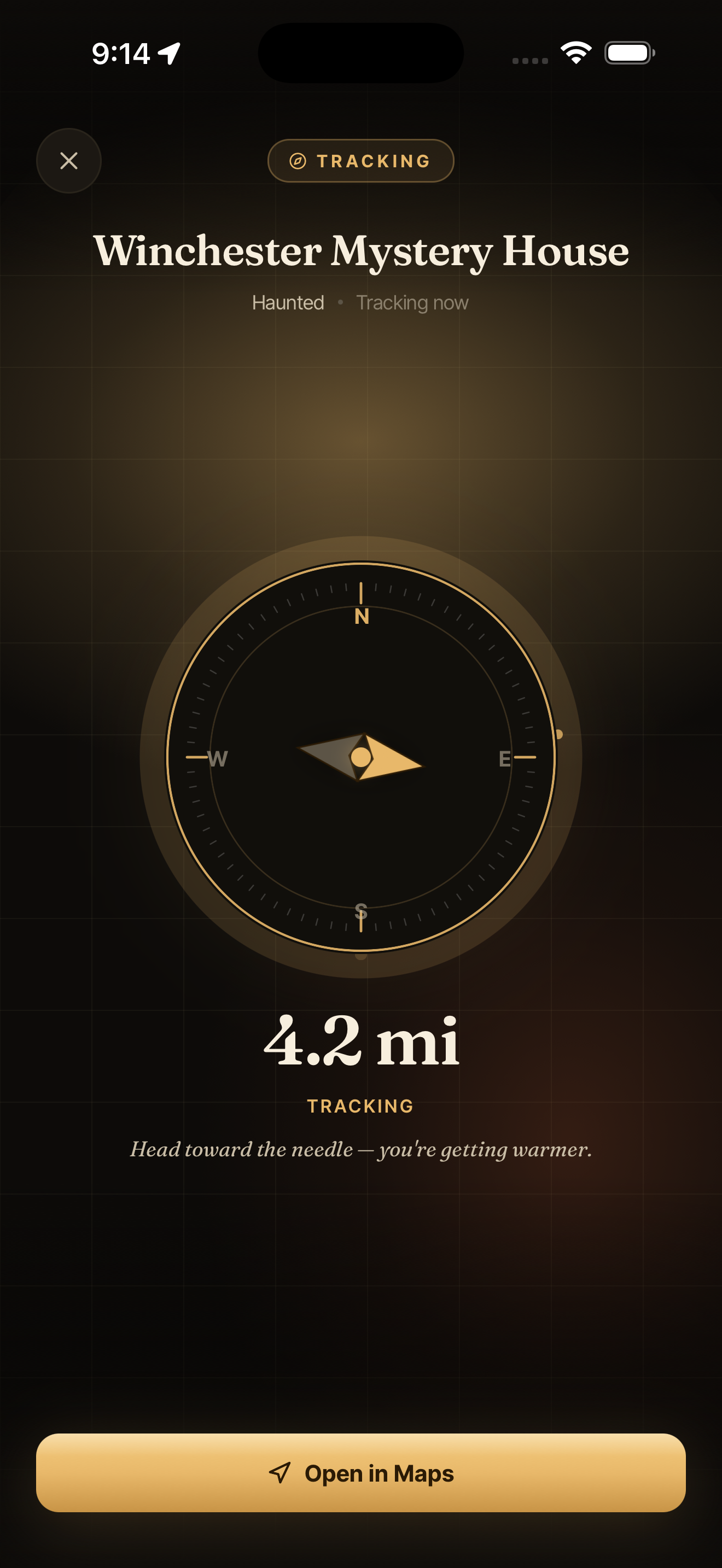
/compass
Live navigation toward one nearby uncollected patch. Draws the real unlock boundary plus a pulsing user marker and the patch pin, over a console showing live distance, a heading dial, and the location photo. Crossing the boundary fires the collect check immediately.
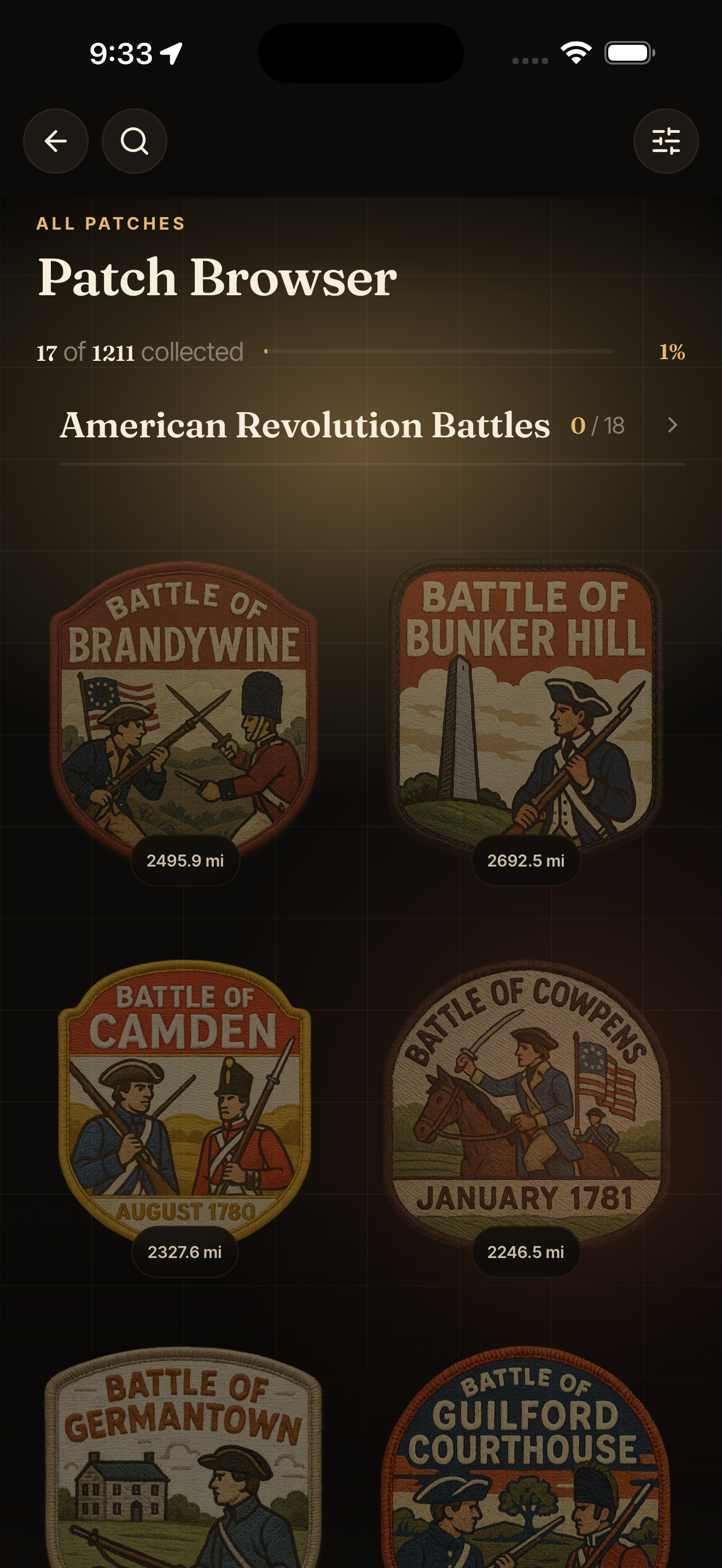
/browse-patches
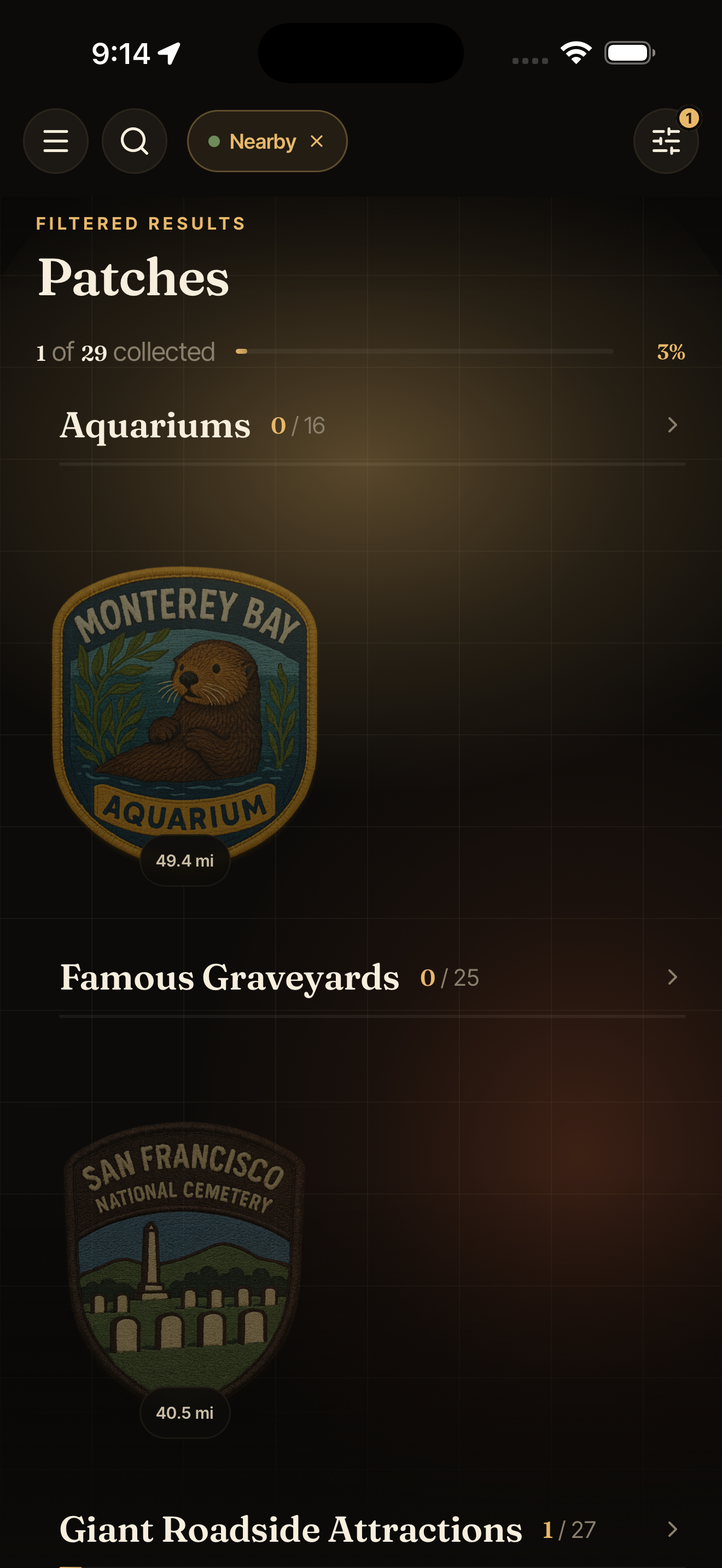
The searchable, filterable catalog: a two-column card grid grouped by collection with per-collection progress headers, removable filter pills, and a search mode offering recents, live suggestions and popular-nearby. Also serves as "Find a patch" and "My Patches".
![Patch Detail — /patch-modal/[id]](/app-screens/patch-modal.png)
/patch-modal/[id]
The full field-guide entry for a place. A hero image pager sits above tabbed content — Overview, History, an optional type-specific tab, Gallery, Community, and My Visit once you have your own photos there — with an action sheet for check-in, directions, feedback and removing the patch from your collection.
![Patch Gallery (Lightbox) — /patch-gallery/[id]](/app-screens/patch-gallery.png)
/patch-gallery/[id]
A fullscreen swipeable pager for a patch’s photos with pinch and pan. Tapping toggles the chrome; community photos can be reported, and your own gallery photos published or unpublished.

/lightbox
The same fullscreen viewer for imagery that has no patch id — post and comment attachments. It reads from a shared store, so a cold deep link shows an empty state and returns.
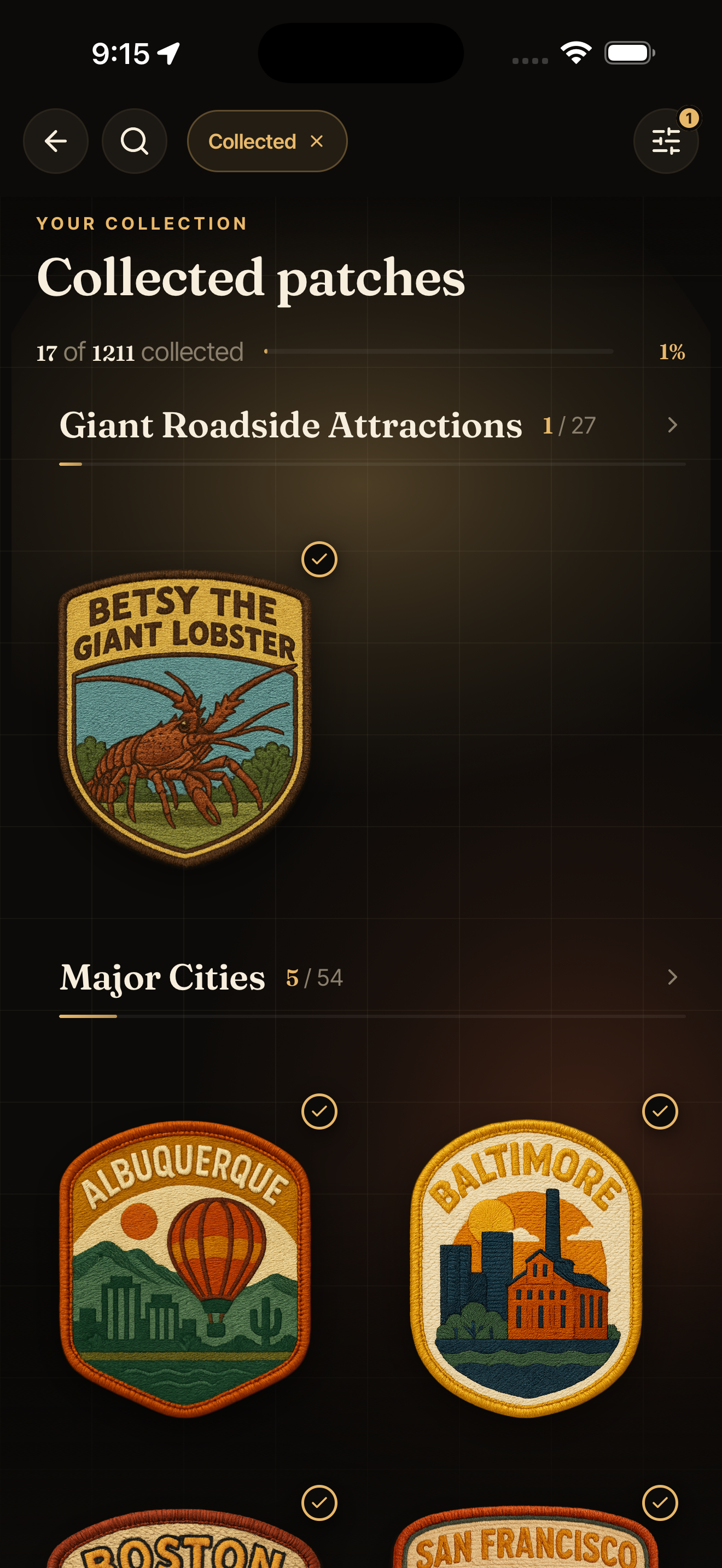
/collected-patches
Achievements grouped by collection, showing only collections where at least one patch is collected. Each section carries its own progress bar, and uncollected patches inside those collections render as silhouettes.
/celebration
The post-collect reward moment: an ember spark field, the artwork rising from silhouette into full colour with haptics and sound, a light sweep, and the place name, then buttons to view the patch or keep exploring. Tapping anywhere skips it; reduce-motion jumps to the final frame.
/submit-patch
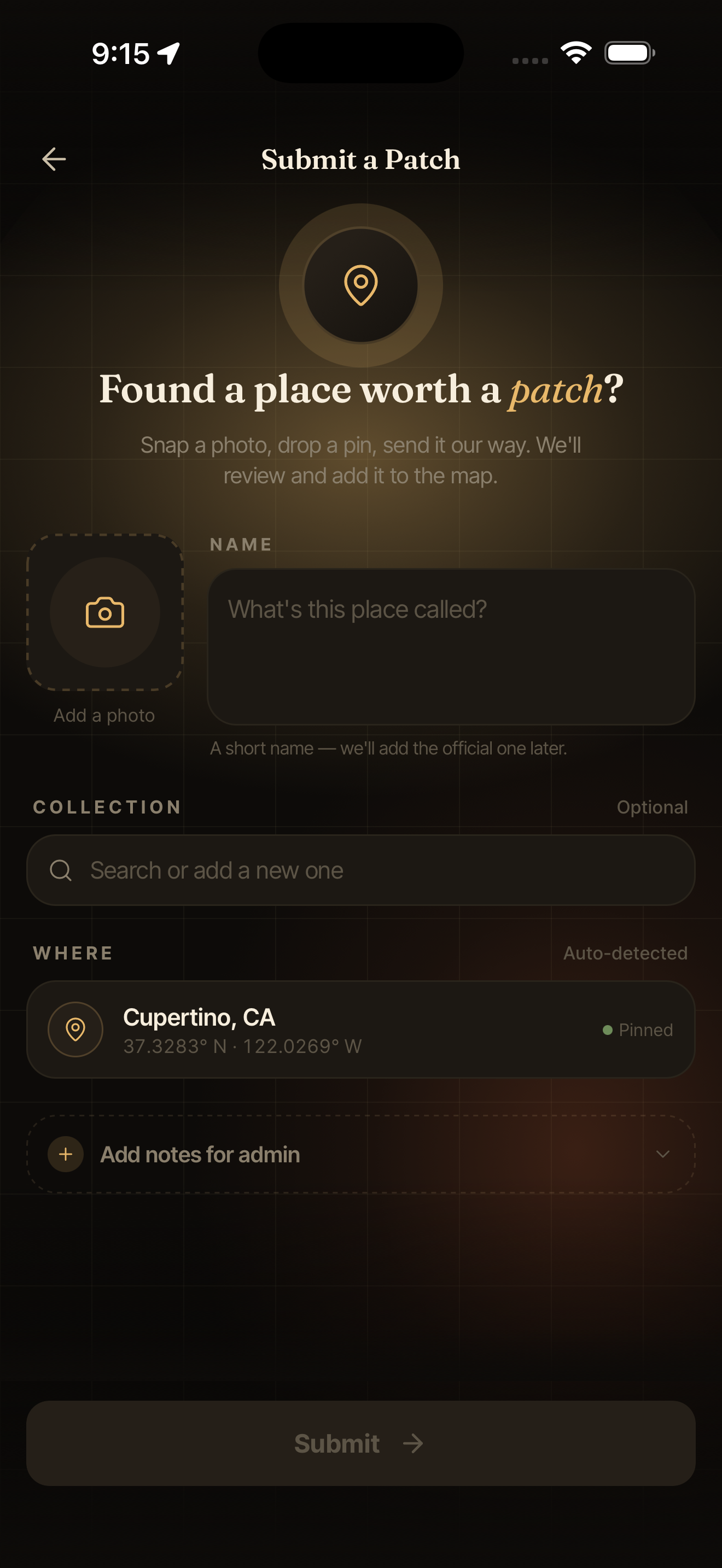
Suggest a new place: a photo, a name, an optional collection, an auto-detected location card, and notes. Currently behind a feature flag that ships off.
/import-modal
The multi-beat camera-roll flow. It scans your photo library — or one album, or hand-picked photos — for coordinate matches against patch boundaries, drawing a route across a map as it goes, then lets you choose what to claim before syncing.
/store-webview
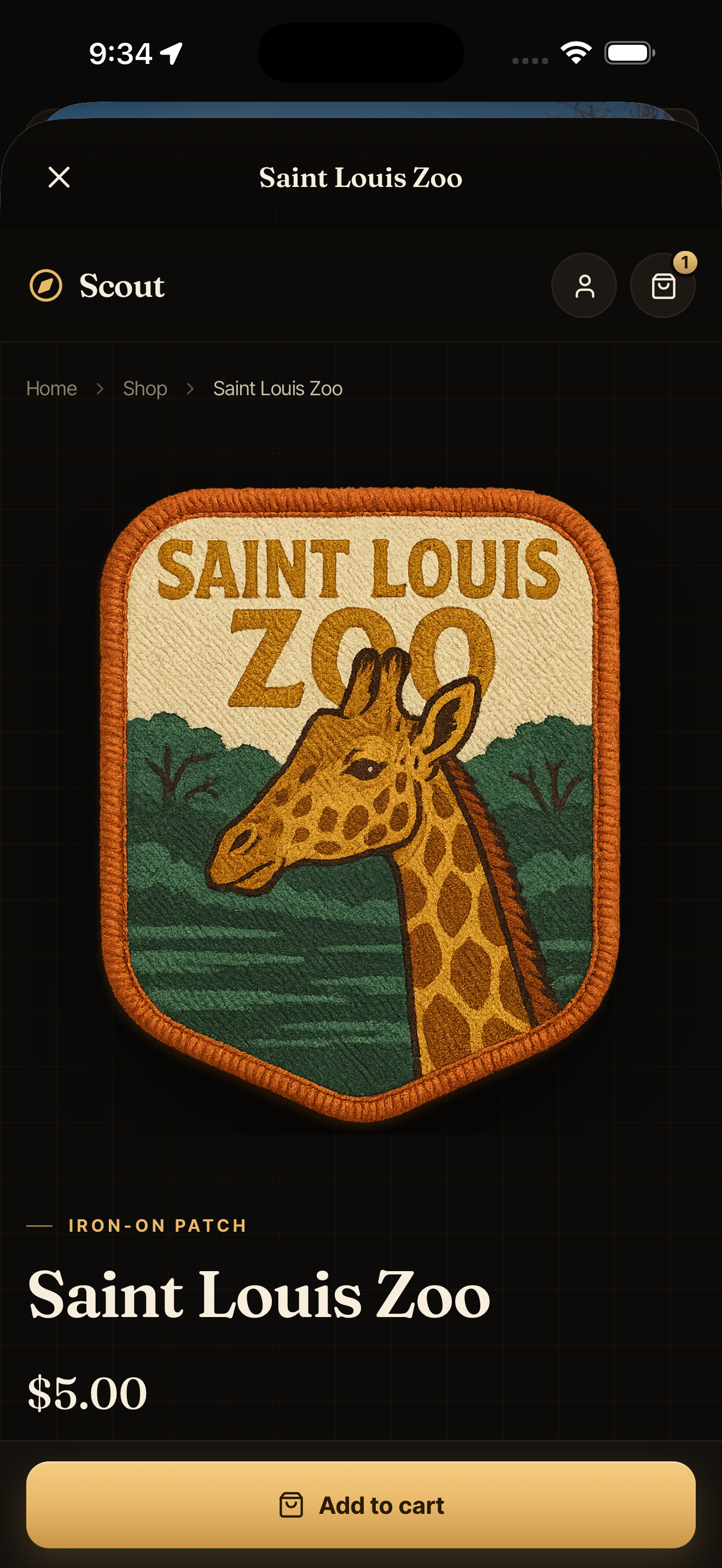
The in-app web view of the shop. It hands off the user’s session so a signed-in scout lands already authenticated and sees the patches they have earned.

/achievements
The badge case: 144 achievements in six families — place types, volume milestones, geographic feats, habits, app fluency, and Wild Cards — shown as a grid of artwork with earned ones lit and unearned ones held back in silhouette. Tapping one opens a sheet with its unlock condition and progress. A header carries the scout's level, experience, and current daily streak. Nothing is hidden: every achievement shows its name and how to earn it from the start.

/(drawer)/campaigns
The top-level browse surface: a snap-scrolling stack of full-bleed campaign covers, two per screen, with a floating masthead washing over the first cover.
![Campaign — /campaign/[id]](/app-screens/campaign.png)
/campaign/[id]
A themed campaign overview — a Ken-Burns hero, a progress summary, and a description, over a trail of stops drawn as an asphalt road with mile markers or a dotted footpath. Single-collection campaigns render their collection directly.
![Campaign Collection — /campaign-collection/[id]](/app-screens/campaign-collection.png)
/campaign-collection/[id]
One campaign stop’s patches under a full-bleed hero, with a progress bar, a toggle between patch-art and photo-card grids, and an all / collected / uncollected filter.

/(drawer)/trips
The Day Trip home, laid out ownership before recommendation: a spotlight hero for your live trip or the best curated trip nearby, then your own trips, a "build your own" row, and a curated shelf.

/(drawer)/road-trip
The Road Trip home — the same layout with A-to-B meta lines instead of distances, and an actionable "Where are you driving?" chip that opens the planner.

/trip-planner
A swipeable deck of nearby patches with undo, plus a grid mode with checkbox tiles and a radius stepper. The candidate list is frozen on open so GPS drift cannot reshuffle the deck mid-swipe.

/road-planner
Two states in one screen: your saved road plans and route presets over a from/to builder, then a stop picker grouping patches along the real driving route into collapsible per-state sections with a detour-distance control.

/my-trips
Every day trip in chronological order, chipped live, saved or done. Saved makes a trip active; done opens a read-only recap.

/trip-preview
A trip before you commit to it: a tappable timeline of its stops and one primary button — resume your own, or start a curated one — with a named warning when starting would replace an active trip.

/trip-map
The live map for the trip you are on, in day-trip or road-trip form, with a bead rail and a driving console. When the trip has just been archived it renders the finale recap — stop order, mileage, drive time.

/trip-stops
The full itinerary as a vertical document: numbered photo discs on a connecting rail, each labelled with category and status — a collected check, a pulsing NEXT UP ring, or the drive leg to the next stop.

/(drawer)/album
Your own photos filed by where you took them. A rotating photo spotlight over a dial that regroups by state, city or campaign, and rows of places with thumbnail stacks. Photos stay on the device.

/cloud-album
Backup status and controls for scouts who have been granted cloud album access, by an admin or by earning it through referrals. Shows how many photos are backed up, what is queued, and lets a place or the whole album be shared by link. Backup runs on Wi-Fi only. Gated behind a flag that ships off, so most accounts never see it.

/album-place
One album page for a single state, city, campaign or place: a spotlight hero over sectioned rows or a single grid. Photos open in a lightbox and can be removed with a confirmation.

/(drawer)/states-map
A share-oriented field record: the US as an inked survey plate shaded by how deeply you have collected each state, three ticket-stub stats, and a share button exporting a portrait card.

/(drawer)/national-parks-map
The sibling record for the national parks — the same plate with a dot per park, an inset for the two off-map parks, and a roll of the parks you hold grouped by region.

/(drawer)/community
The community hub: a live search across every board and post, a strip of the boards you follow, and a new/top sort over the general feed, with a floating new-post button.
![Community Board — /patch-community/[id]](/app-screens/patch-community.png)
/patch-community/[id]
One patch’s own discussion board, with a favourite toggle, a new/top sort, and a feed of posts. Authors who have collected the patch carry a visited badge.
![Post Detail — /post/[id]](/app-screens/post.png)
/post/[id]
A single post — author byline, body, a tappable image carousel, an upvote, and threaded comments supporting reply, like and delete. An overflow menu offers report and block, or delete for the author and admins.
![New Post (board) — /post-create/[id]](/app-screens/post-create.png)
/post-create/[id]
Composer for a new thread on a specific patch’s board — title, body, and optional uploaded photos.

/community-new
Composer for the general, patch-less board reached from the Community hub.
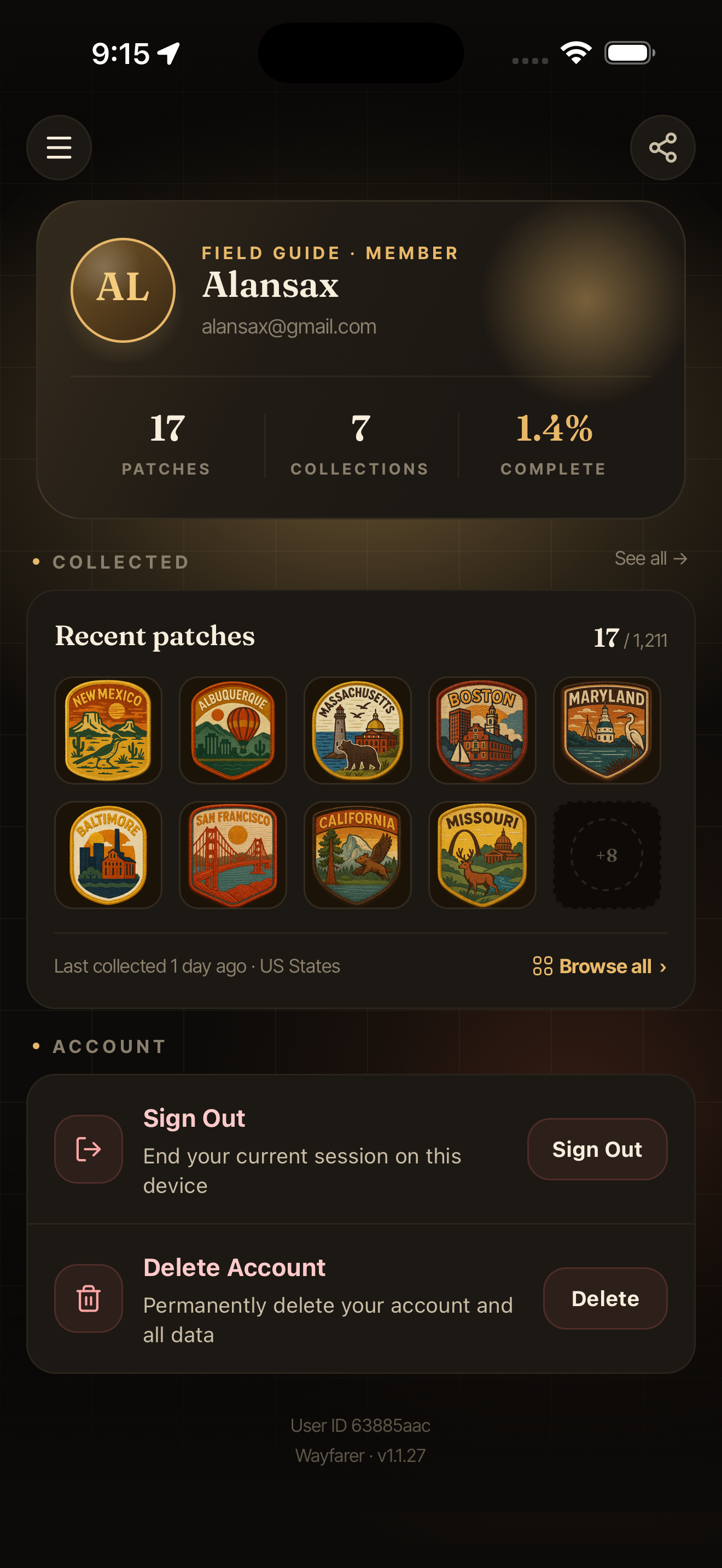
/(drawer)/profile
Identity and progress: avatar, name, a patches-collected progress bar, a grid of recent patch badges, and a share button that opens your public web profile. Account rows offer sign out and delete account.
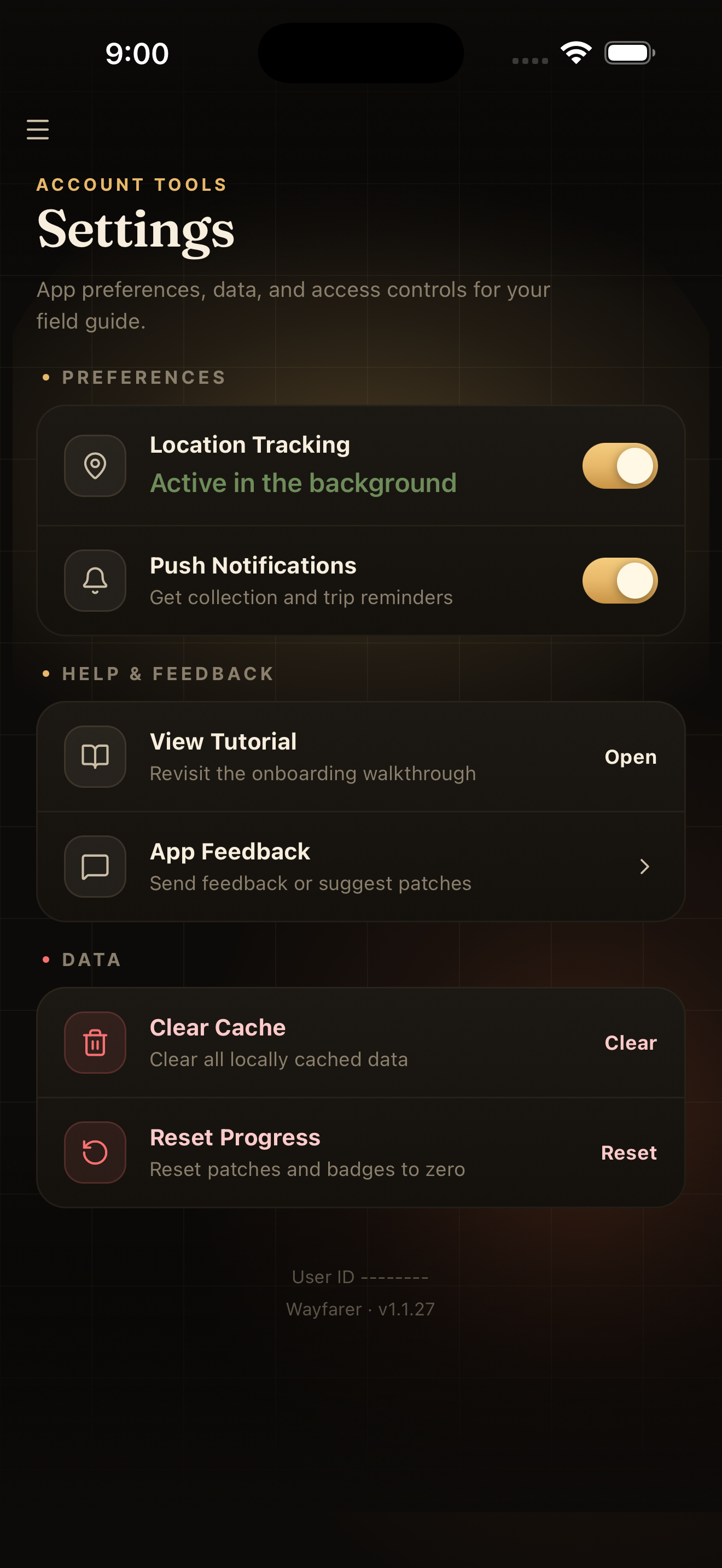
/(drawer)/settings
Preferences (location tracking, notification settings, public profile, click sound), help and feedback, safety and privacy (blocked accounts, privacy policy, terms), and destructive data tools that confirm before running.
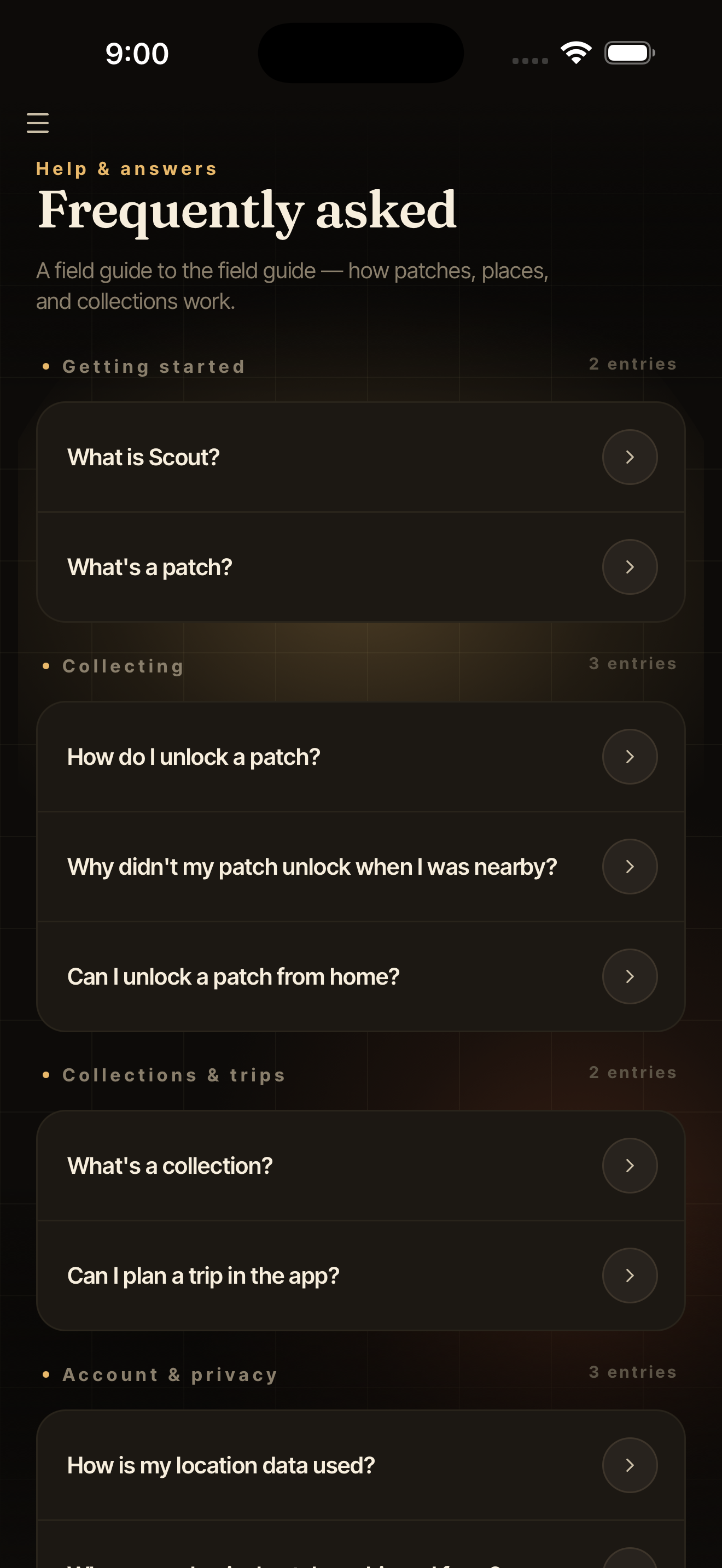
/(drawer)/faq
Server-loaded frequently-asked questions as accordion sections by category, with a help card at the bottom as an escape hatch into feedback.
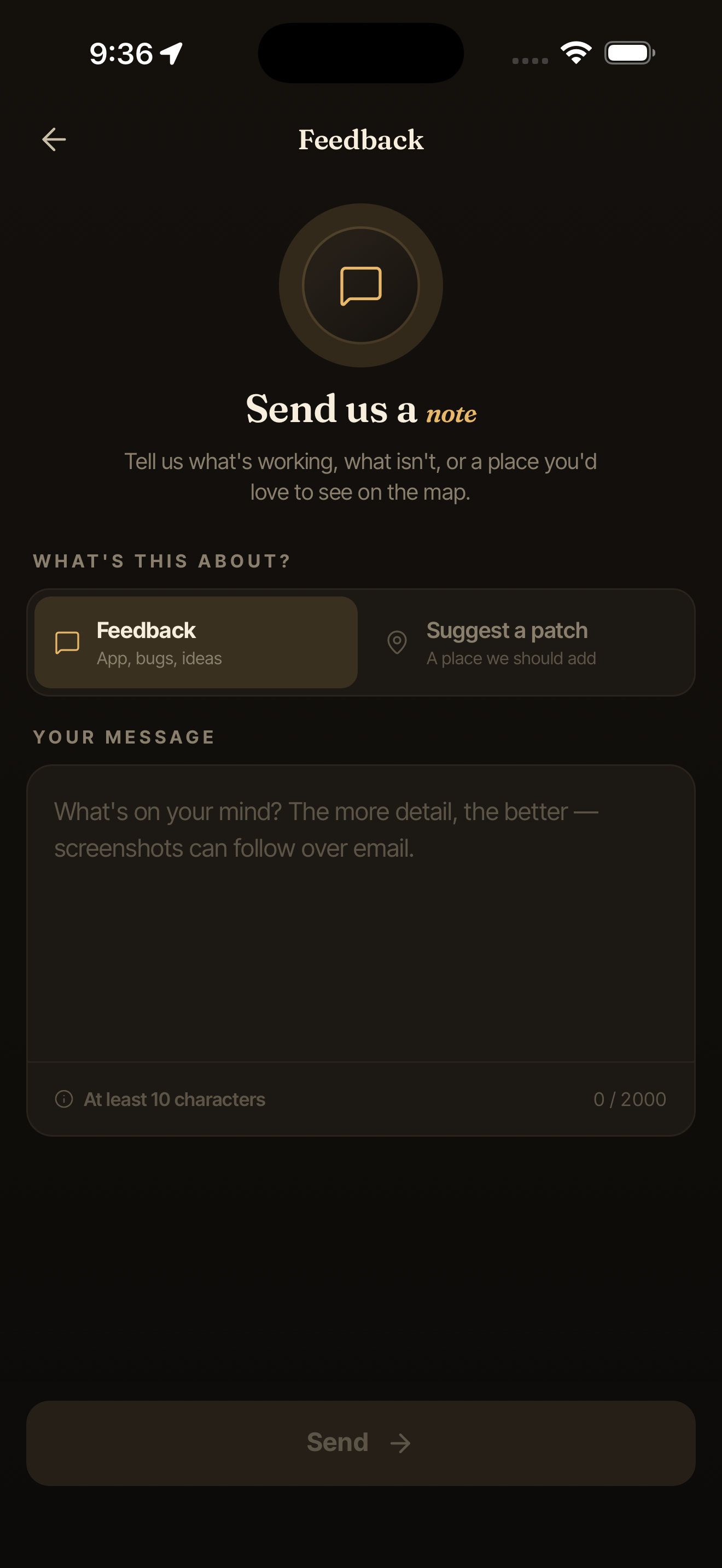
/(drawer)/feedback
A segmented control picks feedback or suggest-a-patch, then a counted textarea feeds a sticky send button. Reached from Settings, the FAQ and the patch action sheet.

/invite
The scout's own invite code with a share action, a count of friends who have joined and qualified, and the three-step reward ladder: permanent cloud album access at three qualified friends, the Scout patch at five, and the Compass Snapback at ten (free for the first 30, then a two-for-one on hats). Nothing pays below three. Also carries the late-entry row for typing in a code you were given, while the claim window is still open.

/rewards
Redirects into the in-app store's own Rewards page: every reward a scout has earned, grouped as Available, Used and Expired, with an Apply-to-cart action on each redeemable one. Reached from a drawer row that badges with the count still unclaimed.

/(drawer)/blocked-accounts
The users you have blocked, each with an unblock action that confirms first. Reached from Settings.

/notifications
Replies, @-mentions, upvotes and messages from Scout. Messages sit in their own lane above the activity feed so an offer is not buried. Repeated events on the same post collapse into one row, and tapping opens the exact post or reply. Mark-all-read and pull-to-refresh; the Home bell badges with the unread count.

/notification-settings
Per-type toggles for replies, mentions, upvotes and messages from Scout, all on by default. Separately, a device-local toggle for the banner your phone shows the moment a patch unlocks.

/messages
Kept as a redirect to the notification inbox so already-shared links keep working. The broadcast inbox it used to render no longer exists.
![Direct Message — /message/[id]](/app-screens/message.png)
/message/[id]
One direct message from Scout in full — title, body and an optional image. Visible only to its recipient.
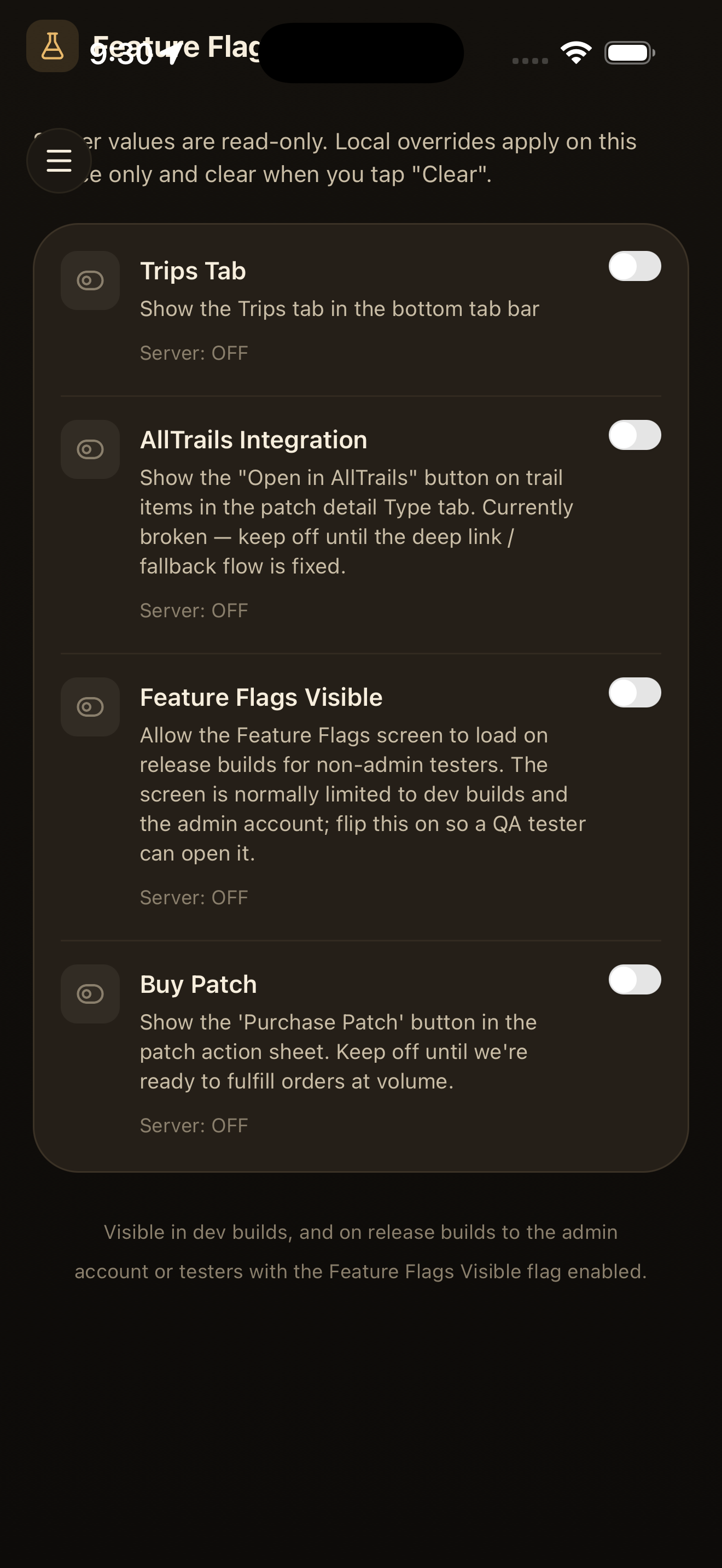
/(drawer)/feature-flags
Every feature flag with its description, server value and any local override, plus a per-flag switch and a clear-override link.
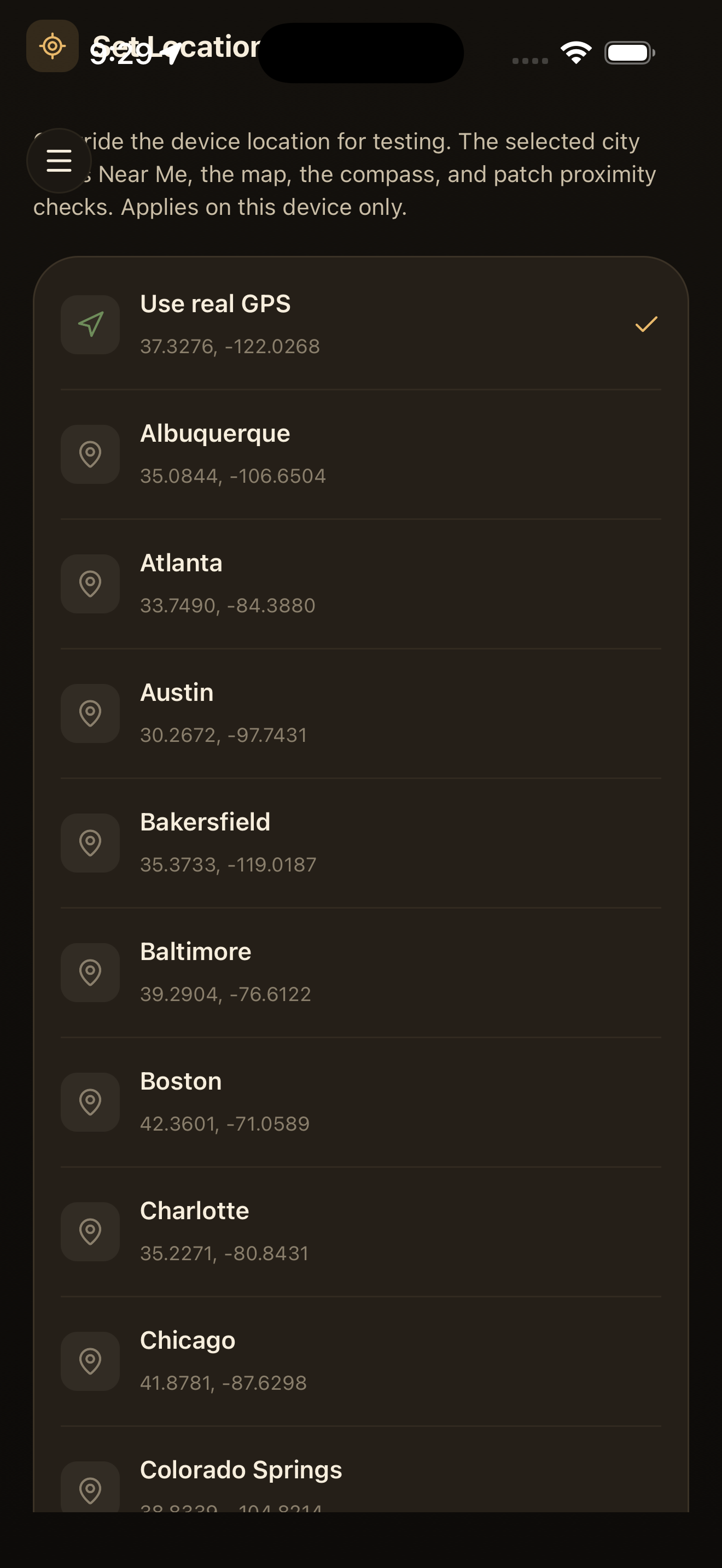
/(drawer)/dev-location
Overrides device GPS for testing — real patch places with nested landmarks, and deliberately off-patch coordinates for exercising empty states. Unlike the map’s city preview, this genuinely moves the user and does feed unlock.

/(drawer)/dev-album-encode
A diagnostic that runs a photo through the cloud-album encode pipeline and reports the result, used to check that portrait, landscape, screenshot, panorama and iCloud-offloaded originals all survive resizing. Temporary tooling, not a product surface.

/screenshot-reset
Resets local state into a known arrangement so App Store and Play screenshots can be captured consistently. Never reachable in a production build.

/(drawer)/dev-deep-links
The in-app launcher for the whole route registry, listing every scout:// URL grouped by category, with a patch picker for routes that take an id.

/(drawer)/dev-simulate-drive
Drives a saved trip programmatically at a chosen speed multiplier to exercise real unlocks along the route.
From Acadia to Alaska
Get your kicks across 8 states
The ridge line and the coast road
A collection to complete for each city!
The land the National Parks didn't get to
All fifty, one region at a time
Muffler men, giant food and the beautifully strange along the American highway
Fifty-four cities, coast to coast. Get inside the city limits to collect!
96 forests, one wild map
America’s most haunted houses, hotels, asylums and grounds
Every arena, ballpark and stadium in the big three
From Sumter to Appomattox
Where the country was argued into existence
Boomtowns, forts and last stands
Twelve thousand years, thirty-five places
Thirty-six American zoos
Twenty-one windows on the deep
Forty terminals, one very frequent flyer
The towns the interstate went around
Must-see landmarks, culture, and high-desert sights across Albuquerque, New Mexico.
UFO watchtowers, alien highways, and the cryptid legends that put small towns on the map.
A curated collection of the best and most notable aquariums across the United States.
Discover the capital of the New South and civil rights history
Keep it weird in the Live Music Capital of the World
Harbor history, ballparks, and cultural landmarks across Baltimore, Maryland.
Giant roadside food sculptures and quirky food museums across America.
Civil rights landmarks and iron-and-steel history across Birmingham, Alabama.
America’s most-visited stretch of scenic road: 469 miles of Appalachian ridge line linking Shenandoah to the Great Smokies.
Walk through American history in the Cradle of Liberty
Architecture, waterfront and wings across Buffalo, New York.
Duck and mimetic architecture — the 1920s-50s boom of programmatic buildings shaped like what they sold.
Antebellum streets, harbor forts and live oaks across Charleston, South Carolina.
Iconic landmarks, museums, and attractions across Charlotte, North Carolina.
Lookout Mountain, the Tennessee River and the Choo Choo, across Chattanooga, Tennessee.
Explore the Windy City's architecture, art, and lakefront
Riverfront landmarks, historic markets and museums across Cincinnati, Ohio.
Must-see landmarks, museums and lakefront spots across Cleveland, Ohio.
Red rocks, America's Mountain, and Front Range icons across Colorado Springs, Colorado.
Statehouse history, arts districts, and Buckeye icons across Columbus, Ohio.
Gulf beaches, a WWII carrier and barrier islands across Corpus Christi, Texas.
JFK history, arts, gardens, and big-league landmarks across Dallas, Texas.
Explore the Mile High City's outdoor adventures and cultural attractions
Motown sound, auto-age innovation, and riverfront landmarks across Detroit, Michigan.
Franklin Mountains, Spanish missions, and border heritage across El Paso, Texas.
A curated collection of historically significant and notable cemeteries across the United States.
Sites one untrained person spent a lifetime building, usually alone.
Cowtown stockyards and a world-class museum district across Fort Worth, Texas.
Underground gardens, Central Valley parks, and historic landmarks across Fresno, California.
Two thousand miles down the spine of the country, following the Mississippi from the headwaters at Lake Itasca — narrow enough to walk across on stepping stones — through Minneapolis, past a pre-Columbian city larger than London was at the time, under the Gateway Arch, along Beale Street, and into New Orleans. Eleven stops, ten states of river.
Beaches, craters and royal history across Honolulu, Hawaii.
Space exploration, the Museum District, and bayou parks across Houston, Texas.
Racing heritage, monuments, and museums across Indianapolis, Indiana.
Beaches, the St. Johns River, and coastal nature across Jacksonville, Florida.
WWI memorial, jazz and baseball heritage, fountains, and BBQ-town landmarks across Kansas City, Missouri.
Iconic landmarks, museums, and natural sights across Key West, Florida.
Experience the Entertainment Capital of the World
Waterfront icons, canals, and coastal culture across Long Beach, California.
Explore the entertainment capital with Hollywood glamour and beaches
Derby racing, bourbon, baseball bats, and Ohio River landmarks across Louisville, Kentucky.
Every Major League Baseball ballpark, from Fenway's Green Monster to Oracle Park's McCovey Cove.
The forty airports that move America — one patch per terminal you actually pass through.
Blues, soul, civil-rights history, and the Mississippi River across Memphis, Tennessee.
Sonoran Desert peaks, ghost-town lore, and museums across Mesa, Arizona.
Experience the Magic City's beaches, art, and Cuban culture
Beer heritage, Harley history, and the Lake Michigan lakefront across Milwaukee, Wisconsin.
City of Lakes art, riverfront milling history, and Mississippi falls across Minneapolis, Minnesota.
The fiberglass giants of International Fiberglass — fewer than 200 still standing.
All 30 NBA arenas, from the Garden's rafters to the Intuit Dome's Wall.
Visit all 30 NFL stadiums across the country
National seashores, preserves, wild rivers, lakeshores, and other natural features managed by the National Park Service.
Experience Music City's country music heritage and vibrant scene
Four hundred and forty-four miles from Natchez to Nashville along a route worn first by animals, then by the Natchez and Chickasaw, then by boatmen walking home upriver after selling their flatboats for lumber. No commercial traffic, no billboards, and no traffic lights on any of it. Eleven stops from an eight-acre ceremonial mound to the columns of a burned mansion, by way of the house Elvis was born in.
Experience the Big Easy's jazz, food, and Creole culture
Explore the Big Apple and its iconic landmarks
Lake Merritt, redwood hills, and Bay-side culture across Oakland, California.
The National Memorial, Western heritage, and Bricktown across Oklahoma City, Oklahoma.
A world-class zoo, the Old Market, and Missouri River landmarks across Omaha, Nebraska.
Visit the Theme Park Capital of the World
US-1 from Miami to Key West, hopping the Florida Keys one bridge at a time on the bones of Henry Flagler's Overseas Railroad — an undertaking called impossible until it opened in 1912, and destroyed by a single hurricane in 1935. Eleven stops from the Art Deco District to the last buoy on the continent, by way of the first undersea park in the country and the only place on earth the Key deer lives.
California State Route 1 — the cliff-edge drive from the redwoods north of San Francisco to the beaches of San Diego.
Discover the birthplace of American democracy
Explore the Valley of the Sun's desert beauty and Southwestern culture
Inclines, rivers and museums across Pittsburgh, Pennsylvania.
Discover the quirky city with books, roses, and waterfalls
The genuinely inexplicable: places whose only reason to exist is that someone did it.
Commissioned civic sculpture — the monuments towns paid for and became known for.
Gold Rush history, the railroad, and the state capital across Sacramento, California.
Witch trial sites, maritime history and old New England in Salem, Massachusetts.
Pioneer history, mountain canyons and the lake itself, across Salt Lake City, Utah.
Experience the Alamo City's rich history and River Walk culture
Experience America's Finest City with beaches and world-class attractions
Discover the City by the Bay with iconic bridges and hills
Silicon Valley tech, cultural districts, and quirky landmarks across San Jose, California.
Explore the charm of Georgia's historic coastal gem
Explore the Emerald City with coffee culture and stunning views
Lincoln's hometown, the Illinois capitol and Route 66, across Springfield, Illinois.
Explore the Gateway City
Theme-park thrills, cigar-city history, and the Riverwalk across Tampa, Florida.
The hundred miles between Austin and San Antonio taken at the pace the hills deserve: a swimming hole under a collapsed cavern roof, a river coming down limestone steps, a president's ranch, a German market town founded in 1846, a billion-year-old granite dome that creaks as it cools, and two dance halls older than most of the roads between them.
Sonoran Desert saguaros, Spanish missions, and sky islands across Tucson, Arizona.
Art Deco architecture, oil-fortune museums, and Route 66 across Tulsa, Oklahoma.
Oceanfront boardwalk, the 1607 First Landing, and coastal nature across Virginia Beach, Virginia.
Tour the monuments and museums of the nation's capital
A curated collection of the best and most notable zoos across the United States.
Beyond the app, Scout serves a set of public, unauthenticated web pages on scout-patches.com. The marketing site and the API share one origin; the shop is a separate storefront on its own subdomain.
/u/<slug>) — a scout's shareable page, opened from the Profile screen's Share button. Headline stats, a grid of collected patch art with an overflow count, completed-collection trophies, and a download-the-app call to action. The slug is generated from the display name plus a short id; the page is on by default with an opt-out in Settings, and guest and opted-out profiles return 404. No personal contact details and no precise personal coordinates./u/<slug>/card.png) — an auto-generated Open Graph image titled "[Name] on Scout — N patches collected", so a shared profile unfurls into a rich preview./api/avatar/<seed>.svg) — deterministic identicon-style avatars, so every scout has a distinct mark without uploading a photo./card) — the permanent destination encoded by a printed QR code; it counts scans and forwards to an admin-configurable target. QR images are served at /card/qr.svg and /card/qr.png./get) — one short link that detects the visitor's device and redirects to the right store listing, falling back to the shipped live listing when the admin config is empty. This is the link the in-app "Invite a friend" action shares./) — a single-screen hero: eyebrow, headline, lede, store badges, and hero art pairing a phone playing the unlock reveal with a macro of the real embroidered patch./app) — the download hub the QR code points at./discover/<patchId>) — the destination for a printed patch QR code: "Patch discovered — you're standing here right now."/brand) — a public but unlisted, noindex brand guide for marketing and contractors, with logo downloads./terms, with /eula redirecting to it) — includes the objectionable-content and abusive-user terms expected of an app with user-generated content./privacy) — the policy referenced by both app stores. A separate policy for the Meta integration lives at /privacy-facebook./support) — the App Store support URL, also opened from in-app Settings and the FAQ./context) — a hidden, crawlable, server-rendered product brief, not linked from anywhere in the app or the marketing site.The app is free and contains nothing paid. There is no subscription, no premium tier, and no working in-app purchase. All revenue is physical goods, sold through a separate storefront.
This changes, and the honest answer today is narrow. The public shopfront is behind a coming-soon wall. The catalog, Store Exclusives, collections, the cart and the general hats category are all closed to the public — verified against production, where every walled path still serves the wall page titled "The shop is in the app". Two things remain open:
Do not write copy implying a browsable public patch catalog until the wall comes down.
Two separate mechanisms are often conflated:
Two honest caveats: the gate fails open, so a backend hiccup never wrongly bounces a real collector, and product pages are reachable by direct URL because the app deep-links straight into them — visibility filtering happens on listing surfaces. This is a purchase gate in the interface, not a cryptographic entitlement.
The storefront is Scout's own, running headless against Shopify: Shopify handles checkout and fulfilment, and the catalog is deliberately unpublished from Shopify's own storefront so there is exactly one place to buy. Checkout is served from its own subdomain.
A signed-in scout opens "Your Store" from inside the app and gets a shop built around what they have actually earned, not a generic catalog. It is not behind the coming-soon wall.
patchCount × $5, not the flat $8 a single patch costs. Adding member patches individually from the grid below never gets a discount, regardless of set completion or whether the bundle price has been applied.The app opens the shop in a full-screen web view from the drawer, from patch detail, and from the celebration screen. The patch-detail and celebration entrances are the "Purchase Patch" buttons, behind the buy_patch flag — which is on in production, so an ordinary scout does see them. They are not an in-app purchase: every one of them opens this web view, and the checkout happens on the web. The session is handed over securely — tokens travel in the URL fragment so they never reach server logs, are re-verified against Scout's own signing keys, and are exchanged for secure cookies before the fragment is wiped from history. It fails open: a missing or invalid token simply means browsing signed out.
This section exists so that anyone — or any AI agent — working from this brief does not describe something Scout cannot do. Read it before writing marketing copy, ad scripts, App Store text, or product documentation. It is reconciled against the per-feature engineering docs in docs/features/, which are written from the code itself.
Polygon-containment unlock · the compass · the celebration · camera-roll retrace · the discovery map · Near Me · the patch browser · patch detail · collections and campaigns · achievements · Day Trip and Road Trip, including turn-by-turn guidance and rerouting · the local Album · community boards and the community hub · reporting, blocking and moderation · messages · referrals and invites · the 50 States and National Parks field records · the public profile and link card · the in-app store handoff.
Describing any of these as a live feature would be wrong.
cloud_album master switch is on in production, but that switch only opens the door: an account also needs an explicit per-account grant before a single photo is uploaded, and no grant has been handed out. The effective state is that nobody's photos leave their phone. Never describe Scout as backing photos up, and never write copy that depends on it, unless someone confirms the grants have started.guest_mode, which ships off. Guest sessions work; whether the button is visible depends on a live flag value.@-mentions resolve against. It is derived once from the email address at signup and there is no editor, no endpoint and no setting that changes it. Scout has usernames; it does not have editable usernames, so never promise a scout they can pick or change their name.patchCount × $5 on 2026-09-02 (197 products, 0 failures). "$5 a patch" is now a true claim and may be advertised, as are "earned, not bought" and "unlock the whole set once you've collected it". Two exclusions remain by decision, not oversight: the fourteen store-exclusive packs are still a flat $8 regardless of size, and the fourteen packs aside, every sellable collection is now priced by size.Scout runs an admin application for content authoring, publishing, moderation, analytics, and store operations, plus an offline geospatial pipeline that produces the boundary polygons. Neither is a user-facing feature and neither should appear in any public description of the product.
Scout uses a single fixed dark theme called the "field-guide" palette — there is no light mode and no user-selectable theme. The aesthetic is deliberately earthy, analog, and tactile: a dark near-black canvas evoking aged paper or leather, brass/gold as the primary accent, and serif headlines in Fraunces paired with tight sans-serif utility text in Inter Tight. The visual language draws from vintage field guides, cartographic instruments, and expedition gear — compasses, embossed brass hardware, worn canvas.
The logo is the Field Rose: a brass compass rose on field-guide black, generated from code so the icon and wordmark cannot drift apart. Its palette is taken directly from the app's own tokens, and the wordmark sets Fraunces SemiBold with deliberately opened-up letter-spacing.
Key tokens from mobile/src/theme/:
canvas #0D0B09 (deepest, near-black with a warm cast) · base #14110D (screen background) · raised #1C1813 (cards) · elevated #251F18 (modals and sheets) · silhouette #0A0805 (the locked patch silhouette).primary #F7EEDD (warm off-white, like aged paper) · secondary #C9BDA6 · tertiary #8A7F6C · quaternary #5C5446 · onAccent #2A1A05 (ink on brass).primary #E8B86A (pins, CTAs, the compass needle, active states) · high #F4CC7E · soft #B89255 · deep #6B4F24, plus a glow and a border tint derived from the same brass.locked / ember #D6663A · collected / moss #6E8C5A · uncollected also #D6663A — a deliberate alias kept under its own name, because "locked" means a collection you have not bought and "uncollected" means a patch you have not earned. Plus destructive, info, and warning states.subtle rgba(255,220,160,0.06) and strong rgba(255,220,160,0.10). Strokes drawn over photography use white instead, since only white survives every exposure.#E8B86A, collected pin #6E8C5A, uncollected pin #D6663A.Fraunces SemiBold (patch names, screen titles, hero numbers), quotes in Fraunces Regular Italic, body and utility text in Inter Tight at Regular / Medium / SemiBold / Bold. The signature is tight negative letter-spacing on the Fraunces display sizes and very wide positive letter-spacing on the uppercase Inter Tight eyebrow labels.#F4CC7E → #E8B86A → #C89446 with a gloss highlight and dark-brown text.Scout's voice is that of a knowledgeable companion who has actually been to these places — unhurried, specific, and quietly proud of the work that went into the catalog. It is adventurous but not hypey; the reward is the place itself and the history behind it, not a dopamine streak. The app treats the user as someone who appreciates well-sourced detail, not someone who needs to be sold to. "Earned, not bought" describes the emotional register: you collect a patch by showing up, and showing up is the point.
Confirmed live copy on the scout-patches.com home page:
Other confirmed brand lines:
In-app copy examples:
Phrases that fit the Scout voice: "places worth the detour," "collect what you've seen," "the patch is proof you were there," "plan the route, earn the patch," "the catalog of everywhere," "history at the ground level."
Hard rules about the unlock mechanic. Say "the patch unlocks when you step inside the real boundary of the place" or "you have to actually be inside the park." Never use radius language — no "within 100m", no "within X feet", no "get close to", no "near it". There is no radius.
Phrases to avoid: "AI-powered," "gamified," "seamless," "robust," "ecosystem," "synergy," generic app-store boilerplate ("This app will change the way you travel"), and any language that makes it sound like a social network or a points race. Scout is not about competing with others or chasing streaks — it is about going to places. Avoid exclamation spam; let the mechanic do the bragging.
An ideal Scout ad follows this arc: a person sets out — car packed, map open, somewhere specific in mind, maybe a trailhead sign or a Civil War marker on a two-lane road. They arrive at the exact location: standing there, looking at the real thing. The compass reads that they are inside, the unlock celebration fires on their phone, and the patch artwork blooms into colour. The feeling is quiet pride, not triumph: proof I was there. A 15–60 second video built around setting out, arriving, and unlocking tells the whole Scout story without a word of explanation.